

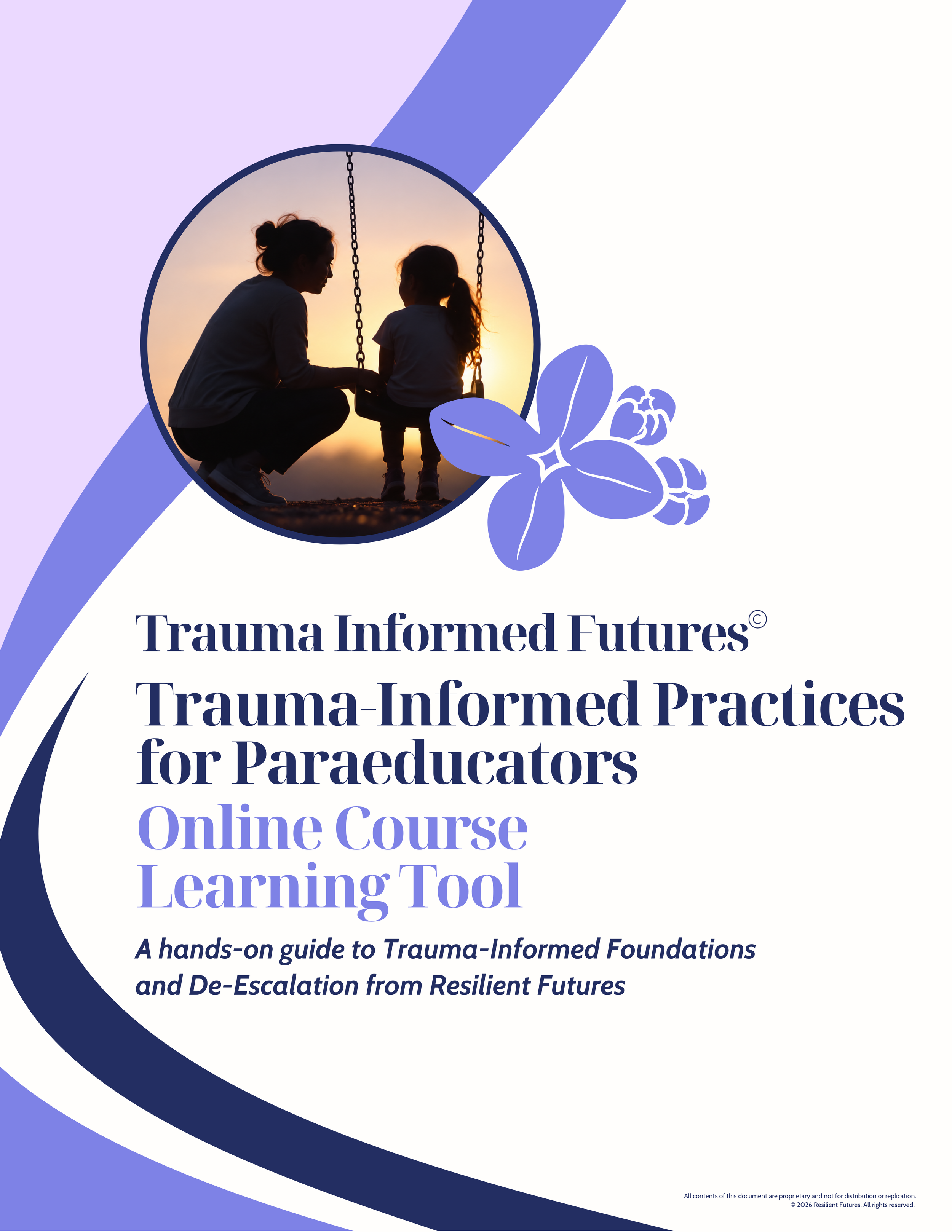
Foundational Training for Paraeducators
A hands-on guide to Trauma-Informed Foundations and De-Escalation from Resilient Futures
Course Summary
Paraeducators play an important role in helping students feel safe, build relationships, and succeed in school. By understanding how trauma and stress can affect children’s learning and behavior, paraeducators can better support students’ needs and help create positive learning environments.
The Trauma-Informed Futures© Foundational Training for Paraeducators provides practical tools and strategies to help paraeducators support children and adolescents who have experienced trauma or ongoing stress. Led by Resilient Futures Co-Founders Dr. Megan Brennan, PsyD, Dr. Eleonora Cahill, PhD, and Dr. Laura McArthur, PhD, the course explores trauma-informed practices for both elementary and secondary school settings.
Participants will learn how to build trust, respond to stress and challenging behaviors, practice cultural humility, and foster resilience. They will also explore how their own well-being affects their ability to support students. Throughout the course, paraeducators will gain practical strategies to help students feel connected, manage stress, and develop the skills they need to learn and grow.
Schools are an important place to build resilience and support children affected by trauma. Through caring relationships and supportive learning environments, paraeducators can help students recognize their strengths, overcome challenges, and thrive.
The course includes the following modules:
Introduction to Trauma-Informed Practices
Cultural Humility and Equity
Stress and the Stress Response
Experiences of Trauma
Escalation Cycles
Fostering Resilience
Adult Wellness
Closing Video: Creating Trauma-Informed Schools
How to take the course: Paraeducators can complete the course individually or work through it as a group with colleagues at their school. Group learning can create opportunities to share ideas, practice new skills, and plan ways to use trauma-informed practices across the school community.
Paraeducators are also known as Classified staff, Teacher Aides, Classroom Aides, Teaching Assistants (TA), Instructional Assistants (IA) or Instructional Aides, Educational Assistants (EA), Ed Techs, Inclusion Aides, or Special Education Paraprofessionals.
For discounted enrollment for a group, district, or organization, contact info@resilientfutures.us.
Individual scholarships are also available; contact info@resilientfutures.us.
Read our Privacy Policy and Online Course Terms & Conditions
-
-
An Introduction to Trauma-Informed Practices
The introduction to the Trauma-Informed Futures© Foundational Training for Paraeducators provides an overview of the training series and introduces Resilient Futures’ framework for trauma-informed, equity-centered practices. Participants will receive guidance on navigating this training and its content while attending to their own well-being and any emotions that arise.
The introduction to the Trauma-Informed Futures© Foundational Training for Paraeducators provides an overview of the training series and introduces Resilient Futures’ framework for trauma-informed, equity-centered practices. Participants will receive guidance on navigating this training and its content while attending to their own well-being and any emotions that arise.
-
-
-
Cultural Humility and Equity
Cultural humility is an important part of being trauma-informed. It means staying open to learning about others rather than assuming we know everything about their culture. It also means reflecting on our own identities and experiences. In this module, paraeducators will learn how to approach each student with curiosity and respect. They will explore how a student’s cultural background shapes their experiences in the classroom.
Cultural humility is an important part of being trauma-informed. It means staying open to learning about others rather than assuming we know everything about their culture. It also means reflecting on our own identities and experiences. In this module, paraeducators will learn how to approach each student with curiosity and respect. They will explore how a student’s cultural background shapes their experiences in the classroom.
-
-
-
Stress and the Stress Response
Understanding stress and how it affects the brain and body helps paraeducators respond to themselves and students with compassion. In this module, participants will learn about different types of stress, common ways people respond to stress, and how the mind and body react during and after stressful experiences. This knowledge can help paraeducators recognize stress-related behaviors, respond with curiosity instead of judgment, and help create a classroom where students feel safe and supported.
Understanding stress and how it affects the brain and body helps paraeducators respond to themselves and students with compassion. In this module, participants will learn about different types of stress, common ways people respond to stress, and how the mind and body react during and after stressful experiences. This knowledge can help paraeducators recognize stress-related behaviors, respond with curiosity instead of judgment, and help create a classroom where students feel safe and supported.
-
-
-
Experiences of Trauma
Trauma can affect how students learn, communicate, handle stress, and interact with others at school. Here, paraeducators will learn about the three E’s of trauma and how certain behaviors may be ways students cope with difficult experiences. They will also explore how positive experiences in childhood can support well-being and growth. The module introduces practical ways to use words, body language, and other actions to help calm stressful situations and support students in the classroom.
Trauma can affect how students learn, communicate, handle stress, and interact with others at school. Here, paraeducators will learn about the three E’s of trauma and how certain behaviors may be ways students cope with difficult experiences. They will also explore how positive experiences in childhood can support well-being and growth. The module introduces practical ways to use words, body language, and other actions to help calm stressful situations and support students in the classroom.
-
-
-
Escalation Cycles and De-Escalation Strategies
In this lesson, paraeducators will learn about the escalation cycle, which describes how stress and emotions can build and lead to challenging behaviors. They will explore the reasons behind these behaviors and learn how to respond through practical strategies to help students manage their emotions and behaviors, both in the classroom and through individual support.
In this lesson, paraeducators will learn about the escalation cycle, which describes how stress and emotions can build and lead to challenging behaviors. They will explore the reasons behind these behaviors and learn how to respond through practical strategies to help students manage their emotions and behaviors, both in the classroom and through individual support.
-
-
-
Fostering Resilience
In this lesson, paraeducators will learn what resilience means and how students can build the skills they need to face challenges and recover from difficult experiences. They will explore neuroplasticity, or how the brain can grow and change through learning and experiences with trusting, supportive adults, like paraeducators. The module also introduces practical ways paraeducators can help students build resilience and feel supported in the classroom.
In this lesson, paraeducators will learn what resilience means and how students can build the skills they need to face challenges and recover from difficult experiences. They will explore neuroplasticity, or how the brain can grow and change through learning and experiences with trusting, supportive adults, like paraeducators. The module also introduces practical ways paraeducators can help students build resilience and feel supported in the classroom.
-
-
-
Adult Wellness
Everyone experiences stress, and paraeducators often support students who have been affected by trauma. In this lesson, participants will learn more about adult resilience through the lens of the stress cycle, compassion fatigue, and compassion satisfaction, which describes the positive feelings that can come from helping others. They will also explore the importance of self-care and communities of care to support their own well-being while caring for others.
Everyone experiences stress, and paraeducators often support students who have been affected by trauma. In this lesson, participants will learn more about adult resilience through the lens of the stress cycle, compassion fatigue, and compassion satisfaction, which describes the positive feelings that can come from helping others. They will also explore the importance of self-care and communities of care to support their own well-being while caring for others.
-
-
-
Closing: Creating Trauma-informed Schools
Trauma can have a strong effect on a student’s ability to learn, build relationships, and feel safe at school. These effects have often been overlooked or misunderstood in education. Paraeducators play an important role in supporting students and helping create a positive learning environment.
Trauma can have a strong effect on a student’s ability to learn, build relationships, and feel safe at school. These effects have often been overlooked or misunderstood in education. Paraeducators play an important role in supporting students and helping create a positive learning environment.
-
Certificate of Completion
Download your official Certificate of Completion for our Trauma-Informed Futures© Foundational Training for Paraeducators.
Download your official Certificate of Completion for our Trauma-Informed Futures© Foundational Training for Paraeducators.
-

Detailed Course Information
-
The short answer: EThis course is designed for paraeducators and the professionals who support, supervise, and collaborate with them in early childhood and K–12 educational settings. Whether participating for individual growth or as part of a broader school or district initiative, the Trauma-Informed Futures© Paraeducator Foundational Training provides practical knowledge, tools, and strategies to strengthen trauma-informed practices and foster more connected, compassionate, and supportive learning environments for all students.
A COURSE FOR:
Individual Learning and Self-Reflection: Build foundational knowledge, deepen self-awareness, and strengthen trauma-informed practices in daily interactions with students.
Onboarding and Training New Paraeducators: Establish a shared foundation of trauma-informed knowledge and practices for new team members.
Ongoing Professional Learning: Reinforce and expand trauma-informed skills within existing school communities.
School and District-Wide Implementation: Support leaders and teams in strengthening collaboration, shaping supportive policies, and creating sustainable, trauma-informed school communities.
-
Estimated Time Commitment: 5 HOURS maximum
The training is a series of learning modules presented in video presentation format varying in length between 4-30 minutes each.
Each Module and subsequent Lessons include activities, reflections, and additional resources to help bolster your knowledge of each topic.
We estimate the maximum 5-hour time commitment based on the completion of all video lessons, accompanying activities & reflections, as well as intro and closing videos.
-
Our self-directed course format includes multimedia resources, such as self-paced narrated training modules, informative videos, downloadable activities, and interactive supplemental resources to further your learning - all designed to explore at your own pace. Upon successfully completing the course and submitting our feedback survey, each participant is eligible to download a certificate of course completion.
-
Our course offering is accessible from any device, anywhere, anytime. After your initial registration, you can log in using your account credentials from your phone, tablet, or desktop computer to track your course progress and experience the lesson curriculum.
All video content is available with closed captioning.
-
Please see our full Privacy Policy and Online Course specific Terms and Conditions: https://www.resilientfutures.us/privacypolicy
Questions about this Online Course?
Please contact us with questions or inquiries about this Online Course or others. We love to hear your feedback as we work to expand our services to reach more people with trauma-informed equity-centered education and practices.

Making an Impact